Parc Natural de la Muntanya de Montserrat
The Montserrat Loop
Local Rider · By Jordi · Vetted by Gritline · Last ridden Jul 22, 2026
69 km·1,800 m
Watch the ride
From 147 m·Up to 746 m·69 km
The route
There's no mistaking Montserrat. The serrated wall of pink rock that erupts out of the plain northwest of Barcelona — all fingers, domes and towers — is one of the most recognisable sights in Catalonia, and its name says exactly what you're looking at: mont serrat, the sawed mountain. What you can't tell from the train window is how it was built. This isn't a peak that was pushed up; it's the compacted floor of an ancient river delta, hundreds of metres of pebbles cemented into conglomerate and then carved into pinnacles by millions of years of erosion. Riding a gravel loop around it is an easy sell. Doing it honestly is not: this is 70 hard kilometres with around 1,800 metres of climbing, technical and dry underfoot — Montserrat's answer to the Pedraforca Loop, and no less of a day.
The long climb to the monastery
We started in Monistrol de Montserrat, down on the Llobregat, where the R5 train from Barcelona sets you at the foot of the mountain. The day opens with its biggest climb — 8.6 km and 700 m up to the abbey, roughly a third of it on gravel — and it does not ease you in. On our mid-summer recon the ground was so dry the rear wheel spun on the steeper pitches, and we walked a couple of short vertical bits. (If you'd rather not fight for traction this early, the paved Carretera de Montserrat climbs the whole way up.)
At the top, wedged onto a ledge two-thirds of the way up the rock, is the Monastery of Santa Maria de Montserrat, founded in 1025 by Abbot Oliba. Inside is La Moreneta — the Black Madonna, a 12th-century Romanesque carving and the patron saint of Catalonia — and, if your timing is good, the Escolania, one of the oldest boys' choirs in Europe, documented as far back as 1307 and still singing in the basilica most afternoons. Fill your bottles here (it's free) and take in the view. The monastery is an out-and-back spur, so you can skip the final ramp up to it and save yourself a few kilometres and metres.
The quiet back side
From the abbey you drop back the way you came and swing west along the northern flank, going past Santa Cecília de Montserrat, a small church consecrated in 959 and one of the oldest things on the whole massif. Since 2015 it has also been one of the strangest — the Irish painter Sean Scully filled its Romanesque shell with huge abstract canvases, frescoes and stained glass, so a thousand-year-old chapel now doubles as a contemporary art space. After that, you turn onto the Pista rural del Casot for the first big descent — fast, paved and generous with the views.
Marganell, gravel, and a 24% wall
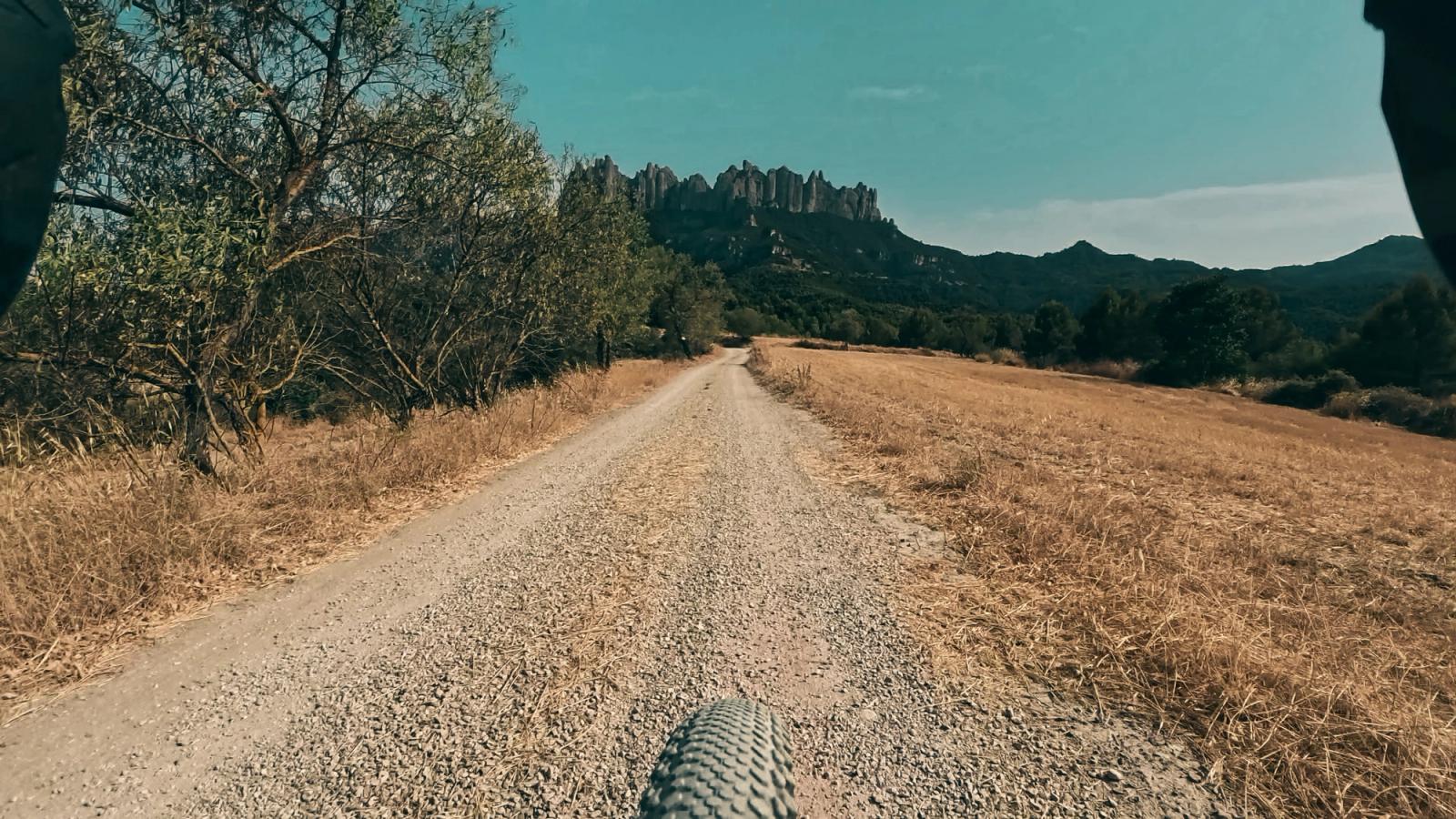
The loop curls back south past Marganell, its hilltop church of Sant Esteve the local landmark, and onto some of the best gravel of the day — pointed straight at the serrated wall of the mountain, which is a genuine sight. The climb that follows plays its own trick: gentle at first, then it bares its teeth on a short ramp that touches 24% just before it rejoins the Carretera de Montserrat. Out of the saddle, teeth gritted — and then, mercifully, smooth tarmac and room to breathe.
Down to Olesa, and a sting in the tail
What goes up: from here it's a long drop, mostly gravel, down the southern face — from 700 m to about 50 — past olive groves and the handsome Vinya Nova masia (we only stopped for water, and it made us want to come back) and on to Olesa de Montserrat. Then the sting in the tail: the day's last big climb, into the Reserva Natural de Puigventós and up to the Coll de les Espases, where Montserrat shows itself again, now from the southeast. After that it's rolling ground and a closing ribbon of gravel back down into Monistrol — the cherry on the cake.
Getting there
The R5 from Barcelona (Plaça d'Espanya) reaches Monistrol de Montserrat in about 65 minutes. Bikes travel in the designated spaces, though it's a squeeze at rush hour.
Bailouts and when to ride
If you need to return to Barcelona, you can cut the day short and take the same R5 home from Olesa de Montserrat. You can also trim the route by skipping the loop past Marganell and staying on the Carretera de Montserrat. Spring and autumn are the pick — the gravel grips better and the climbs are cooler; in high summer, start early, because that first ascent bakes in the afternoon.
Surface mix
Granular surface breakdowns (singletrack, mud, rock, etc.) live in Komoot, open the GPX there for the full picture.
Comments
Be the first to share notes
Drop some feedback or share a note if you've ridden it recently, surface shifts, trail closures, water points.
Become a Gritliner to leave notes on routes.
Sign up, free